Squirrels are amazing climbers. They can climb down trees headfirst. In fact, they can climb up and down chimneys and walls headfirst. And they love to live inside homes, including attics, ceilings, soffits, eaves,
and walls. If you hear the scurrying of little feet up and down the walls of your house, especially during daytime, morning and evening, you've probably got squirrels in your walls. The methods for removing squirrels
from the walls are pretty similar to the methods for removing them from the attic. Find the entry points outside, set one-way exclusion doors or live cage traps, catch all the squirrels, seal the holes, find the nest of
baby squirrels if any, and remove them.

In this photo, we see a nest with a couple of juvenile squirrels bundled up in a nest in the wall. The mother squirrel has brought down a pile of pink insulation for the nest. I caught and removed the mother squirrel, but it still had this nest of young down in the wall, so I had to cut a hole in the wall and remove the young by hand. Even young squirrels can have a nasty bite, so I used thick welder's gloves, and held them so that they were unable to bite me. Another option is to mount a trap to the wall and wait for them to come out into the trap on their own time, but it's easier for an expert to grab them by hand.
NEED LOCAL HELP? We are wildlife removal professionals servicing 95% of the USA. Click here to hire our local squirrel removal expert in your home town. Updated 2021. But read the below advice first!
Although squirrels are amazing climbers, they must have at least something to grip onto. Squirrels are used to being able to climb wherever they want. But if a man-made surface is unusually slick, such as a smooth drywall, they can fall down and are unable to climb back up. In this case, you'll hear a whole lot of frantic scratching at the bottom of your wall. Some people call me out in time, adn I am able to get to the house and remove these squirrels, by cutting a hole in the wall. Another option would be to lower a rope down the wall from the top, down from the attic, and let the squirrel climb up and out, but then you've still got to get it out of the attic. And not all walls are accessible from the attic.
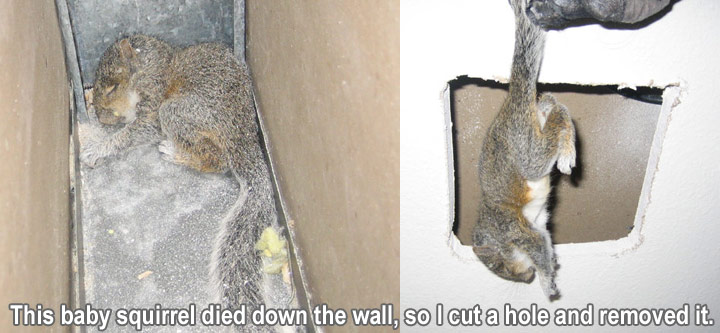
In this photo, a lazy and careless homeowner let a small squirrel scratch at the bottom of the wall for days, then die of exhaustion and dehydration. She didn't do anything about it until the bad odor started. At that time she called me, and I came and removed the dead juvenile squirrel from the wall. It's better to get it out when it's alive, rather than wait for it to die.
What do squirrels in the wall sound like? Read about animal noises in the attic during the day or a discussion on are squirrels ever active at night?
Will Squirrels Chew Through The Ceiling or Wall - Squirrels will chew through virtually anything they see. It is imperative for them to chew in order to grind down their constantly growing teeth. Once they are living in your attic, squirrels will investigate to see what they can find, and often crawl into the walls. If they find even the tiniest weakness in the ceiling, perhaps where the electrical wires lead to the ceiling light, they may pursue this as a good chewing point until they are all the way through the opening and in your room. Some people think that if they are hungry enough, they may think at first that the sheet rock that is your ceiling or wall is food and gnaw on it. But the reality is that they just want to wear down their teeth. They may gnaw on the wood that is holding up the sheet rock, making it vulnerable to break. There are many different ways a squirrel can be responsible for tearing up your ceiling or walls. The point is, that yes, squirrels will chew through the ceiling. They will have no problem doing it. So the best course for you is to make sure that you do not have squirrels in your attic or under your roof. Taking away the possibility to chew their way through your walls or ceiling is the best way to have a safe and healthy home. Periodically, check under your eaves to see if there are holes that can be used by squirrels.
Here is an email that I received regarding squirrels in the wall:
Hi, After searching the internet I came to your site, I wish you were located in Wisconsin! We owner occupy a house with separate apartments and recently have been dealing with some animal pest issues. I have been able to take care of everything myself up until this point (trapping rabbits & Squirrels and relocating them to forest land) but I got a frantic call last night from a tenant that she heard an animal in her wall and was worried. I calmed her down said I could be over tomorrow to check it out, and that our old house has 3 layers so its unlikely the animal would get through ( 2 layers drywall and the original lathe and plaster - house built in 1894). I know this because I cut some holes in the walls to shoot in insulation and couldn't believe how thick it was, but then I started thinking about it and I don't have any experience with animals inside walls whatsoever and I would feel horrible if it did get through and scare the bejeezes out of her! So I told her she had an open invitation to stay with us if she was worried and that I didn't want her to lose sleep over it (she said the animal woke her up about 5:30 am today). The strange thing is that she pointed out on the wall where she heard the noises and the animal had made it to different rooms - from the bathroom over to the kitchen, which is 15 feet away or so and not on the same wall.
So I'm wondering what the animal could be, though I have a good guess. I gave her some mice traps to set as she told me on the phone she heard scratching and not whining or squeaking (and we have had bats in basement, which probably came in through the attic and I recall they would squeak so probably not bats). A few weeks ago however, we had a squirrel trying to nest in the attic, and while it never actually made it into the attic I was able to isolate where it was going once on our roof (which happens to coincide with the same wall as this girls apartment). It was way up in the crevice of the roof, I know I need to close off the hole but I haven't for two reasons:
1) I didn't want to trap the mom or babies in the wall
2) I couldn't safely get that high
I think I may have unknowingly trapped the mother squirrel, I found a few dead babies outside and while I don't know how many babies a normal squirrel litter is, we had no problems for a few weeks and I thought problem was solved. That is until I got the frantic call from this tenant.
I have an idea how to seal it off that part of the house (our house is has old woodwork at the top, by where you'd normally see gable vents) by attaching some kind of steel wire and or chicken fencing so no birds, squirrels or bats can get up there, and from reading your website I'd be interested to hear the proper way to close that off. But the more pressing issue currently is this animal in the wall. I need to figure out:
1) What it is
2) If its dangerous to the tenant in terms of being able to enter the apartment through the wall, or even dangerous in terms of eating through wiring and causing a housefire or short
3) The best removal method (preferably without drilling holes, but if need be then thats what we do).
4) I called the number on your webpage for the city in my area (La Crosse, WI) and was told they're not too sure how to help me - gave me the number of a local trapper guy but said they thought he only worked with outside animals. I fear that I may be out of my league on this one and don't want to be cutting holes in the wall myself without really knowing what I'm looking for or how to find it. Still, if I can't find a professional locally the problem isn't going away on its own (unless it dies in the wall) - it which case
5) If it is a baby squirrel and dies in the wall somewhere, how bad will the smell be and for what duration? And what if its only a mouse or a rat (though we don't have many rats around here that I know of, I've never seen one but that might not mean much if they just don't come into contact with humans)
Again, your website is a great resource, thank you for any help / advice.
Daniel
PS, I will try to dig up more some pictures of our house and the squirrel that I took when I first saw it if I can find them. In the picture I included, the girls apartment is on the lower floor of the exact wall shown here, and the squirrel was up in the very corner of the house behind the woodwork at the tip of the roof!
In this photo, we see a nest with a couple of juvenile squirrels bundled up in a nest in the wall. The mother squirrel has brought down a pile of pink insulation for the nest. I caught and removed the mother squirrel, but it still had this nest of young down in the wall, so I had to cut a hole in the wall and remove the young by hand. Even young squirrels can have a nasty bite, so I used thick welder's gloves, and held them so that they were unable to bite me. Another option is to mount a trap to the wall and wait for them to come out into the trap on their own time, but it's easier for an expert to grab them by hand.
NEED LOCAL HELP? We are wildlife removal professionals servicing 95% of the USA. Click here to hire our local squirrel removal expert in your home town. Updated 2021. But read the below advice first!
Although squirrels are amazing climbers, they must have at least something to grip onto. Squirrels are used to being able to climb wherever they want. But if a man-made surface is unusually slick, such as a smooth drywall, they can fall down and are unable to climb back up. In this case, you'll hear a whole lot of frantic scratching at the bottom of your wall. Some people call me out in time, adn I am able to get to the house and remove these squirrels, by cutting a hole in the wall. Another option would be to lower a rope down the wall from the top, down from the attic, and let the squirrel climb up and out, but then you've still got to get it out of the attic. And not all walls are accessible from the attic.
In this photo, a lazy and careless homeowner let a small squirrel scratch at the bottom of the wall for days, then die of exhaustion and dehydration. She didn't do anything about it until the bad odor started. At that time she called me, and I came and removed the dead juvenile squirrel from the wall. It's better to get it out when it's alive, rather than wait for it to die.
What do squirrels in the wall sound like? Read about animal noises in the attic during the day or a discussion on are squirrels ever active at night?
Will Squirrels Chew Through The Ceiling or Wall - Squirrels will chew through virtually anything they see. It is imperative for them to chew in order to grind down their constantly growing teeth. Once they are living in your attic, squirrels will investigate to see what they can find, and often crawl into the walls. If they find even the tiniest weakness in the ceiling, perhaps where the electrical wires lead to the ceiling light, they may pursue this as a good chewing point until they are all the way through the opening and in your room. Some people think that if they are hungry enough, they may think at first that the sheet rock that is your ceiling or wall is food and gnaw on it. But the reality is that they just want to wear down their teeth. They may gnaw on the wood that is holding up the sheet rock, making it vulnerable to break. There are many different ways a squirrel can be responsible for tearing up your ceiling or walls. The point is, that yes, squirrels will chew through the ceiling. They will have no problem doing it. So the best course for you is to make sure that you do not have squirrels in your attic or under your roof. Taking away the possibility to chew their way through your walls or ceiling is the best way to have a safe and healthy home. Periodically, check under your eaves to see if there are holes that can be used by squirrels.
Here is an email that I received regarding squirrels in the wall:
Hi, After searching the internet I came to your site, I wish you were located in Wisconsin! We owner occupy a house with separate apartments and recently have been dealing with some animal pest issues. I have been able to take care of everything myself up until this point (trapping rabbits & Squirrels and relocating them to forest land) but I got a frantic call last night from a tenant that she heard an animal in her wall and was worried. I calmed her down said I could be over tomorrow to check it out, and that our old house has 3 layers so its unlikely the animal would get through ( 2 layers drywall and the original lathe and plaster - house built in 1894). I know this because I cut some holes in the walls to shoot in insulation and couldn't believe how thick it was, but then I started thinking about it and I don't have any experience with animals inside walls whatsoever and I would feel horrible if it did get through and scare the bejeezes out of her! So I told her she had an open invitation to stay with us if she was worried and that I didn't want her to lose sleep over it (she said the animal woke her up about 5:30 am today). The strange thing is that she pointed out on the wall where she heard the noises and the animal had made it to different rooms - from the bathroom over to the kitchen, which is 15 feet away or so and not on the same wall.
So I'm wondering what the animal could be, though I have a good guess. I gave her some mice traps to set as she told me on the phone she heard scratching and not whining or squeaking (and we have had bats in basement, which probably came in through the attic and I recall they would squeak so probably not bats). A few weeks ago however, we had a squirrel trying to nest in the attic, and while it never actually made it into the attic I was able to isolate where it was going once on our roof (which happens to coincide with the same wall as this girls apartment). It was way up in the crevice of the roof, I know I need to close off the hole but I haven't for two reasons:
1) I didn't want to trap the mom or babies in the wall
2) I couldn't safely get that high
I think I may have unknowingly trapped the mother squirrel, I found a few dead babies outside and while I don't know how many babies a normal squirrel litter is, we had no problems for a few weeks and I thought problem was solved. That is until I got the frantic call from this tenant.
I have an idea how to seal it off that part of the house (our house is has old woodwork at the top, by where you'd normally see gable vents) by attaching some kind of steel wire and or chicken fencing so no birds, squirrels or bats can get up there, and from reading your website I'd be interested to hear the proper way to close that off. But the more pressing issue currently is this animal in the wall. I need to figure out:
1) What it is
2) If its dangerous to the tenant in terms of being able to enter the apartment through the wall, or even dangerous in terms of eating through wiring and causing a housefire or short
3) The best removal method (preferably without drilling holes, but if need be then thats what we do).
4) I called the number on your webpage for the city in my area (La Crosse, WI) and was told they're not too sure how to help me - gave me the number of a local trapper guy but said they thought he only worked with outside animals. I fear that I may be out of my league on this one and don't want to be cutting holes in the wall myself without really knowing what I'm looking for or how to find it. Still, if I can't find a professional locally the problem isn't going away on its own (unless it dies in the wall) - it which case
5) If it is a baby squirrel and dies in the wall somewhere, how bad will the smell be and for what duration? And what if its only a mouse or a rat (though we don't have many rats around here that I know of, I've never seen one but that might not mean much if they just don't come into contact with humans)
Again, your website is a great resource, thank you for any help / advice.
Daniel
PS, I will try to dig up more some pictures of our house and the squirrel that I took when I first saw it if I can find them. In the picture I included, the girls apartment is on the lower floor of the exact wall shown here, and the squirrel was up in the very corner of the house behind the woodwork at the tip of the roof!
Go back to the Squirrels in the Attic home page.
NEED SQUIRREL REMOVAL HELP? We service over 150 USA cities. click gere to hire us in your home town. Updated 2021.