NOTE: I have received so many requests for professional help with squirrel removal, that I have made this complete listing of hundreds of (link ->) professional squirrel removal experts who I trust, serving every city in the USA.
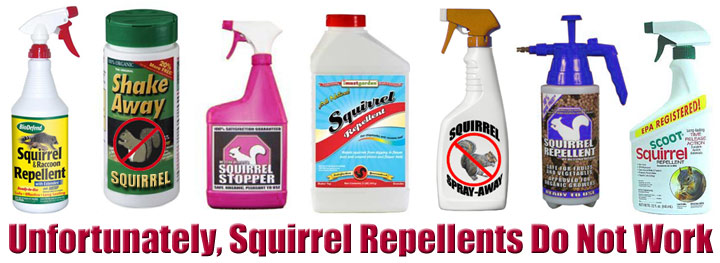
That said, in general there are many long-standing old wives' tales about animal and repellent, and there are many modern products sold meant to evict unwanted critters from property and homes, and most all of them are bogus. Some of the old-fashioned standards include naphthalene (moth balls), ammonia, bleach, and even human hair. The idea behind these repellents is that they simply create an unpleasant odor that squirrels don't like, which encourages them to leave. In my years of experience as a wildlife removal professional, I've seen many of these tactics used in an attempt to evict squirrels. I've never seen them work, but that's also because in the cases they do, I'm not called out. The problem is that an attic is large and well-ventilated, and the odor isn't very strong. A squirrel will often just move to another, less offensive part of the attic. Even in cases in which the odor is strong, it's not enough incentive to make the animal leave. Once a squirrel has established a home in an attic, it takes more than a bad odor to make it leave - you wouldn't abandon your home if someone spread some mothballs inside. This is a wild animal that needs to survive, and it will tolerate quite a bit in order to keep its home. That includes all of the current repellent and deterrent products sold.
NEED LOCAL HELP? We are wildlife removal professionals servicing 95% of the USA. Click here to hire our local squirrel removal expert in your home town. Updated 2021. But read the below advice first!
If you do an online search, you will find all sorts of squirrel repellants sold, many with confident money-back guarantees. Most of them are made of ...mothballs. In fact, most animal repellents sold are made from either mothballs or coyote urine. I've been to many homes at which the homeowner has placed a great deal of mothballs in the attic - one had fifty pounds of mothballs! - and the squirrels didn't care. They also don't respond to coyote urine. Some people recommend the use of bright lights, strobing lights, or noises. The most common noise deterrents are regular radios and ultrasonic high-pitch sound emitting devices. Once again, I've seen both of these tactics used multiple times to no effect. In fact, the FTC has issued an official warning against the high-pitch noise machines, stating that they are 100% ineffective and fraudulent. Read more about Will a bright light or high pitch sound deterrent machine work on squirrels?
It'd be nice if a simple product would solve the problem. That goes for any most any cheap and easy fix for a serious problem. The truth is that repellents rarely work. Go ahead and try every one of them if you're not convinced, and then take care of the problem properly when you discover that cheap repellents are pointless. Some people have asked me about the use of poison for squirrels, but there is no registered legal poison, nor any effective one that I know of. And if poison does work, you'll just end up with the stench of rotting squirrel carcasses in your attic. Always use trapping and removal to get rid of squirrels.

Above we see a photograph of a squirrel being forced out of a building through a one-way exclusion door. This is just one example of the many ways to solve a squirrel problem effectively, rather than through the attempted use of bogus products.
Although there are no sprays, lights, noisemakers, electric fences, electronic devices, etc that work, there are several squirrel prevention techniques that you can employ to help prevent squirrel problems.
Due to requests from readers for competent and honest wildlife professionals to assist with squirrel problems, I have been doing research on the matter, and can confidently recommend companies in these USA cities and towns: - AZ Phoenix, CA Los Angeles, CA Oakland, CA San Diego, CA San Francisco, CA San Jose, CO Denver, DC Washington DC, FL Boca Raton, FL Fort Lauderdale, FL Jacksonville, FL Miami, FL Orlando, FL Tampa, GA Atlanta, IL Chicago, IN Indianapolis, MA Boston, MD Baltimore, MI Detroit, MI Grand Rapids, MN Minneapolis, NC Charlotte, NC Raleigh, NJ Newark, NY Long Island, NY New York City, OH Cleveland, OH Columbus, OH Cincinnati, OR Portland, PA Philadelphia, PA Pittsburgh, SC Columbia, TN Knoxville, TN Nashville, TX Austin, TX Dallas, TX Fort Worth, TX San Antonio, VA Arlington, WA Seattle, WI Milwaukee.
What Sickness Can Be Caused By Using Squirrel Repellents -
An interesting question asks what sickness can be caused by using squirrel repellents. A lot of people look for repellents as a way to rid themselves of pests that can invade your home just to find that they were ineffective and that in some cases have left them feeling ill. That is sometimes the case because the smell that they produce is strong and the person inhaling the repellent for a long time will begin feeling that sickness. Generally repellents will not get you sick in the long term, but mothballs and ammonia can cause headaches. Mothballs (naphthalene) are also a known carcinogen, so they can possibly cause
cancer in people, but it seems like everything can cause cancer, so what can you do. There is always a chance that the repellent will work on a person better than it works on squirrels.
The main concern is not the sickness that it they may cause on people, but rather the sickness that they may cause on your pets. A lot of these repellents emit toxins that may not affect you, but that can be really bad for your dog or cat. Even if the repellent is not getting your dog or cat sick with its smell, there is a chance that they will eat some of that repellent and in some cases that can lead to severe sickness. Mothballs for example are used as a repellent, but they smell bad and are toxic.
Here is information about how to keep squirrels away from garden.
I reside in Brooklyn, New York. I am part owner of this two family house with an attic that has a squirrel which constantly annoys and worries me. I am the only one who lives on the top floor and have very little money to hire a
professional to get the squirrel out. I have already tried four boxes of mothballs, but that didn't work. I have read on the website that fox urine would keep them away. I have looked in home depots for ultra sound transmitters which they did not have. I have tried turning the radio on a talk station
in the daytime also I have turned the attic lights on and off when I am at home so that it would be annoyed and leave it worked for a while but not any more. I am very disgusted with the situation and have considered moving out.
The squirrel has gotten in by a whole in the roof. I have also gotten an estimate of repairing this roof which is 4,500. On top of all this I have also heard the faint sound of a bird. Please tell me if fox urine would keep the squirrel
out since I don't want any more visitors or any other kind of ideas on how to keep squirrels away, I would greatly appreciate.
Read other articles about squirrels:
How smart are squirrels?
Home remedies to keep away squirrels and get rid of them
What are some ways to kill a squirrel in the yard?
Humane ways to kill a squirrel in a cage
How to get rid of squirrels without killing them
How to keep squirrels out of your house
Go back to the Squirrels in the Attic home page.
NEED SQUIRREL REMOVAL HELP? We service over 150 USA cities. click gere to hire us in your home town. Updated 2021.